
German Roaches vs. American Roaches in Southeast Texas
Joshua Culver · October 9, 2026 · Roach Control
German and American cockroaches require different inspection priorities. Learn what their size, location, and behavior can reveal.
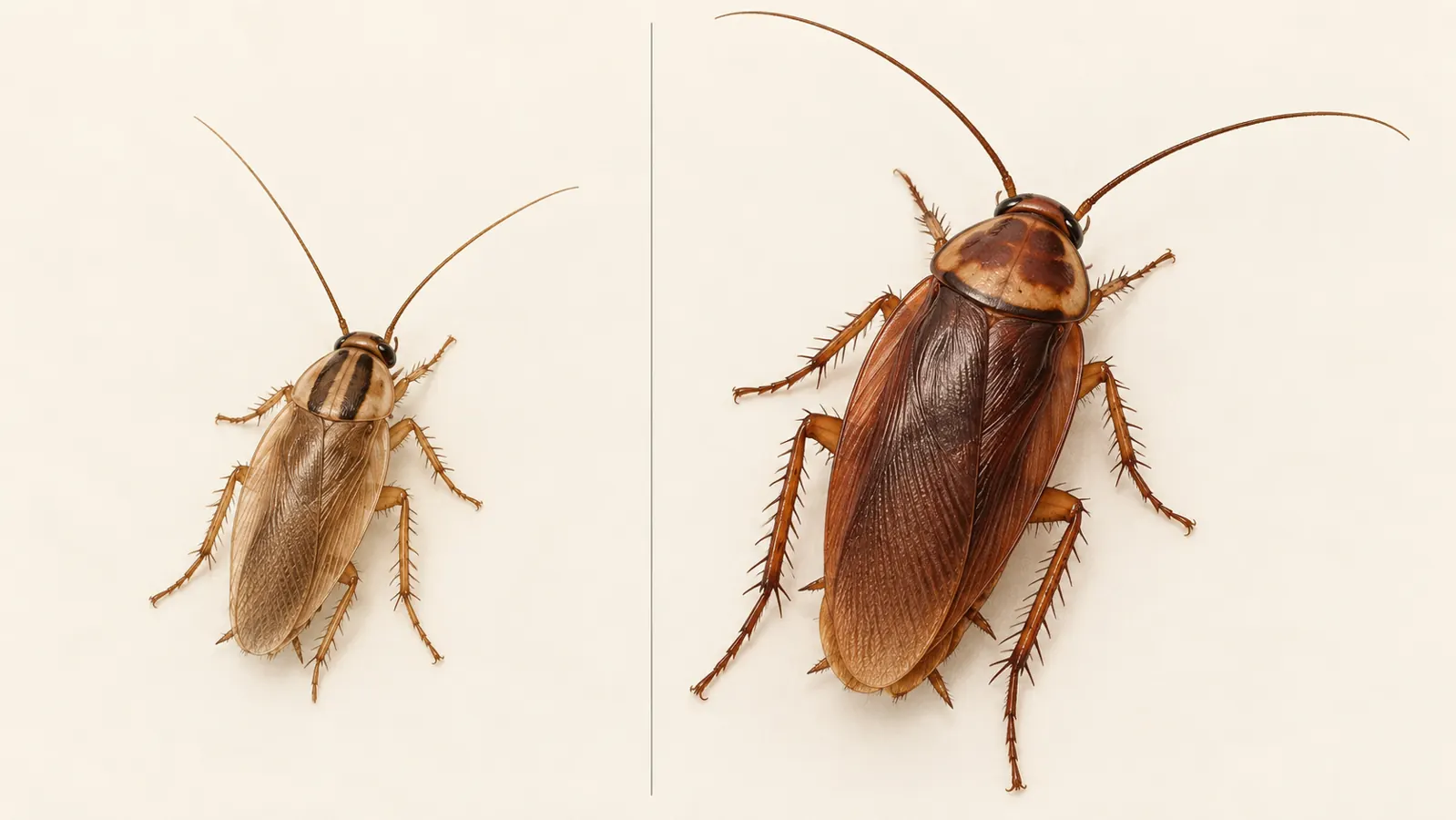
German roaches and American roaches require different control plans. Adult German roaches are small, tan and marked by two dark stripes behind the head; American roaches are much larger and reddish brown. Identification helps determine whether to inspect indoor breeding sites, exterior entry routes, or both.
A photograph can help, but location and pattern are just as important. Note whether the insect appeared in a kitchen cabinet, around plumbing, in a garage, near a floor drain, or outside after rain. That context helps distinguish an indoor breeding infestation from occasional entry.
How to tell adult German and American roaches apart
- German cockroach: about 1/2 to 5/8 inch as an adult, light brown to tan, with two dark parallel stripes behind the head.
- American cockroach: much larger—often around 1 1/2 inches or more—reddish brown, with a lighter yellowish margin behind the head.
- German cockroach: commonly associated with kitchens, bathrooms, appliances, cabinets, and other warm areas close to food and water.
- American cockroach: often associated with sewers, drains, basements, utility areas, crawl spaces, and warm, damp exterior or structural locations.
Size is useful only when you are comparing adults. Young American cockroaches can be smaller, so markings, habitat, and a professional identification may be needed.
Why German roaches demand fast attention
German cockroaches live and reproduce readily inside buildings. They hide in narrow cracks near food, warmth, and moisture, including cabinet hinges, appliance motors, wall penetrations, and clutter. Seeing them during daylight can indicate heavy pressure because the best hiding places may already be crowded.
They can move with grocery items, cardboard, used appliances, furniture, bags, and deliveries. In apartments, they may also travel along plumbing and utility routes. Treating one visible surface without addressing harborages and movement paths commonly leads to a rebound.
Why American roaches often point to moisture or entry
American cockroaches are strong travelers and may enter from outdoors, drains, sewer-connected areas, roof or wall voids, and utility spaces. Repeated sightings can point to moisture, damaged screens, door gaps, plumbing openings, vegetation against the building, or an accessible harborage.
An indoor sighting does not prove a large colony is living in the kitchen. Inspection should extend to the building perimeter, roofline, crawl space, drains, storage, and moisture sources as appropriate.
What both species need
Cockroaches need food, water, shelter, and access. Crumbs matter, but so do grease films, pet food, recycling residue, plumbing condensation, leaky pipes, cardboard, and tiny crevices. A clean home can still receive cockroaches through deliveries or neighboring units; sanitation is one control component, not a moral judgment.
- Store food and pet food in sealed containers.
- Clean grease and crumbs beneath and beside appliances.
- Repair leaks and dry damp cabinets or utility areas.
- Reduce cardboard and dense clutter near kitchens and storage rooms.
- Seal appropriate gaps around pipes, baseboards, doors, and shared walls.
Why random spraying can make control harder
Spraying only where roaches are seen may miss the cracks where they rest and reproduce. Some repellent products can move activity into new areas or interfere with bait placements. Never combine products casually; follow every label and the technician’s preparation instructions.
A professional roach-control inspection uses species, distribution, sanitation, moisture, monitors, and activity level to choose placements and follow-up. The plan may combine baits, targeted products, vacuuming, exclusion, and monitoring rather than depend on one broad spray.
Information to give your technician
- Where and when you saw activity
- Whether insects appear during daylight
- Recent appliance, furniture, grocery, or cardboard deliveries
- Leaks, drain problems, or persistent humidity
- Other units or adjoining businesses reporting activity
- DIY products already applied and where they were used
Photograph before disposing
A clear photo beside a coin or ruler can help show size. Avoid crushing the identifying markings if you can safely capture the specimen.
How treatment differs by species
| Question | German cockroach | American cockroach |
|---|---|---|
| Likely source | Indoor harborage or transported item | Outdoor, sewer, drain, crawl-space, roof, or damp structural route |
| Inspection center | Kitchen, bathroom, appliances, cabinets, shared plumbing | Drains, utility rooms, exterior, roofline, crawl space, damp voids |
| Monitoring | Many small monitors close to harborages | Monitors near entry and moisture routes |
| Core correction | Food, grease, water, cardboard, cracks, adjoining-unit movement | Leaks, drains, screens, doors, vents, vegetation, exterior access |
| Common mistake | Surface spray that misses breeding sites | Treating the kitchen while ignoring exterior or sewer-linked entry |
Both species may require targeted product use, but the table explains why species identification must come before treatment. The same aerosol applied in the same place is not a plan.
A room-by-room roach inspection
- Kitchen: inspect hinges, drawer tracks, appliance motors, plumbing, grease, and cardboard.
- Bathroom: inspect vanity gaps, plumbing, condensation, and warm devices.
- Laundry and utility: inspect drains, leaks, water heaters, and wall penetrations.
- Garage and storage: inspect doors, boxes, pet food, and exterior access.
- Exterior: inspect vegetation, mulch, drains, soffits, vents, and moisture.
Place monitors where they will not be disturbed and label the date. Counts and species reveal whether activity is concentrated, spreading, or being reintroduced.
Frequently asked questions
Are large roaches always American cockroaches?
No. Southeast Texas has several large cockroach species. Color, markings, location, and a specimen or clear photograph help produce a reliable identification.
Can German roaches come from a clean neighboring apartment?
They can move between units through shared walls and utility routes, and they can arrive in transported items. Effective multifamily control often requires coordination beyond one unit.
Why do I keep seeing roaches after spraying?
Hidden egg cases, untreated harborages, moisture, food, new introductions, and product interference can all contribute. Reinspection and targeted follow-up are more useful than repeatedly spraying visible surfaces.
Are German roaches harder to eliminate than American roaches?
German roaches reproduce indoors and occupy many small harborages, so they often require intensive preparation, baiting, monitoring, and follow-up. American roach control can be difficult when structural moisture or entry remains.
Why do large roaches appear after heavy rain?
Rain can change outdoor and sewer-related conditions and drive cockroaches toward shelter. Inspect drains, door gaps, roof and crawl-space routes, and moisture.
Should neighboring apartment units be inspected for German roaches?
Shared plumbing and walls can allow movement. Management and the professional should use the evidence and building layout to decide which connected units need inspection.
Can a clean house have German roaches?
Yes. They can arrive in groceries, cardboard, appliances, furniture, bags, or from adjoining units. Sanitation affects control but does not prove how they arrived.
Related reading
- Pest and roach control services
- Lumberton pest control
- Why roaches keep coming back after spraying
- Request an inspection
Sources and further reading
Get help identifying and treating roaches
Save a clear photograph or specimen if you can do so safely. Tell BugMan which rooms are affected and whether sightings are occasional or happening every day. Call (409) 333-9165 or request a free estimate.
Have a pest concern? Let’s take a look.
Request a free initial inspection.
Tell us what you’re seeing and our local team will help you choose the right next step. Serving Beaumont, Nederland, Lumberton, Buna, and surrounding Southeast Texas communities.
Prefer to call? (409) 333-9165


General Pest Control Services
Termite Treatment & Prevention
Crawfish Treatment
Rodent Control
Roach Control
Bee Removal
Mosquito Control
Flea & Tick Control
Ant & Wasp Control
Residential Pest Control
Commercial Pest Control
2026 Bug Man Pest & Termite Control © - Site by: 414 Creative


