
Can You Stay Home During Pest-Control Treatment?
Joshua Culver · October 19, 2026 · Pest Control Safety
Some inspections and exterior services allow occupants to remain; other treatments require everyone to leave. Get a specific answer before service.
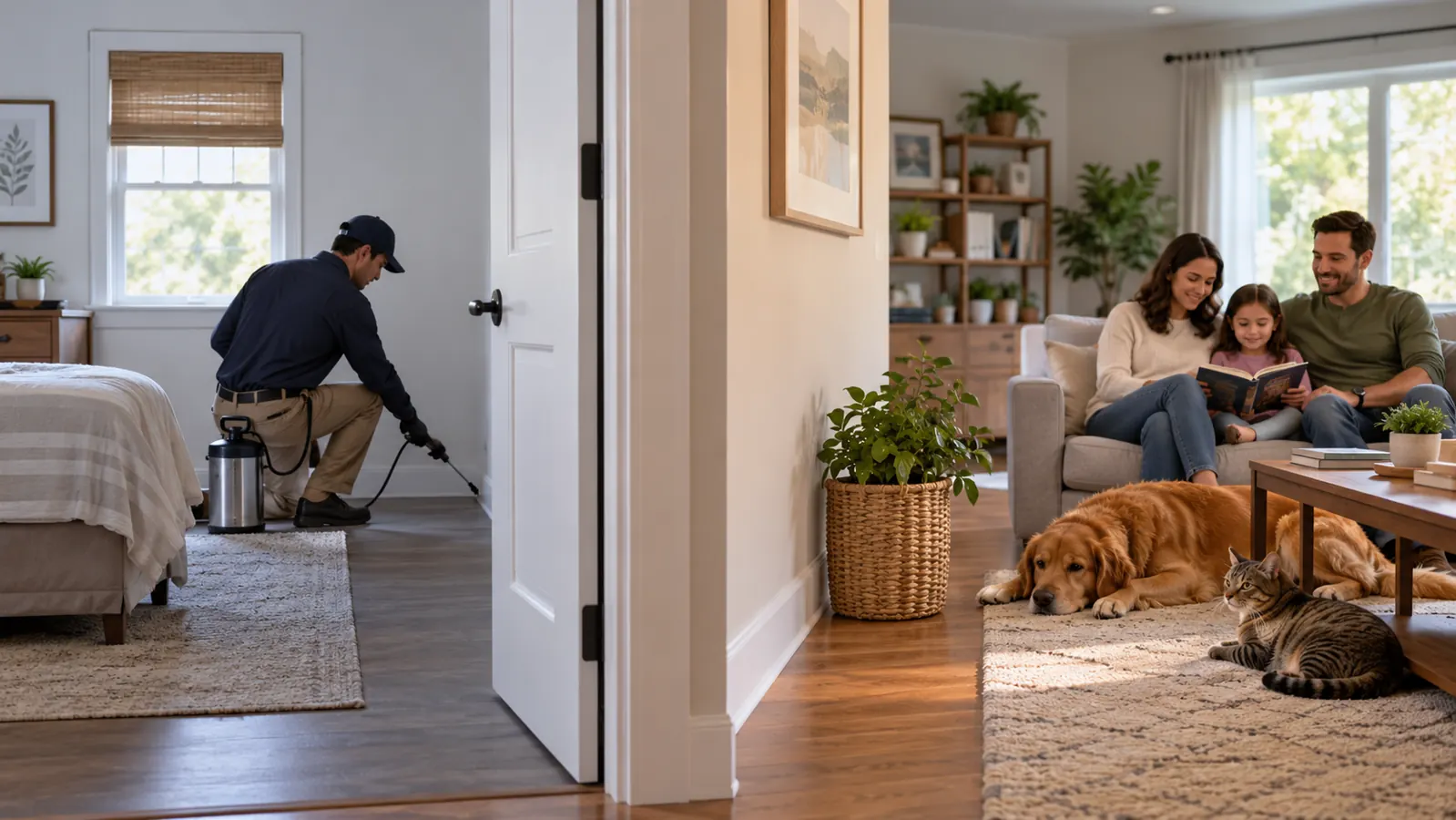
Whether you can stay home depends on the treatment, product label, rooms involved, and the people or animals who may be exposed. There is no single stay-or-leave rule for every pest-control visit.
Ask before the appointment so you can plan transportation, work, school, pet care, and access. The technician should provide clear instructions for leaving, re-entry, ventilation, cleaning, and anything that must remain undisturbed.
When you may be able to stay home
A visual inspection, exterior-only service, monitor check, trap service, or treatment in a fully separated area may allow occupants to remain, provided the product label and site conditions permit it. The technician may still ask people and pets to stay away from the active work zone.
Remaining home does not mean following the applicator from room to room. Give the professional space to inspect and apply material without interruption or accidental contact.
When you may need to leave
- Bed-bug heat treatment
- Total-release fogger use
- Certain broad interior applications
- Treatments whose label requires vacancy or a defined re-entry interval
- Work where ventilation or sensitive occupants create additional concern
- Applications in small spaces that cannot be isolated
The required time is not a universal number. It comes from the product label, method, completion time, ventilation instructions, and the company’s site-specific directions.
Children and pets need a specific plan
Infants and young children spend more time near floors and put hands or objects in their mouths. Pets may lick treated surfaces or contact wet outdoor residues. Birds, fish, reptiles, and small mammals can have special sensitivity and housing constraints.
Tell the company about every occupant and animal before product selection. Do not assume that covering an aquarium, placing a bird in another room, or opening a window is sufficient unless instructed.
Five questions to ask
- Which rooms and exterior areas will be treated?
- Who must leave, including pets, and at what point?
- What exact event starts the re-entry clock?
- Is ventilation required before re-entry?
- What may be cleaned afterward, and what must remain untouched?
Ask for the departure, re-entry, and cleaning instructions in writing. Save them with the service report and product information.
What to do when you return
Follow the written re-entry and ventilation directions. Keep children and pets from treated or baited areas. Do not wash away residual placements or remove monitors unless instructed. If surfaces used for food preparation require cleaning, confirm the correct process.
BugMan’s pest-control service includes preparation and follow-up guidance. The related home preparation checklist helps organize questions before the visit.
If instructions are unclear
Pause and ask. Do not rely on smell as a safety test; some products have little odor, and odor alone does not measure exposure. If accidental exposure occurs or someone feels unwell, move away from the area as appropriate and contact emergency services, Poison Control, or a medical professional based on the situation and label first-aid directions.
The label controls
Never shorten a required vacancy or re-entry period because the surface looks dry or the room no longer smells. Follow the label and professional instructions.
Stay-or-leave guidance by service type
| Service situation | Possible occupancy instruction | Why you must confirm |
|---|---|---|
| Inspection or monitor check | Occupants may often remain | Attics, crawl spaces, ladders, pets, and privacy can still require separation |
| Targeted crack, crevice, bait, or trap work | Some areas may remain usable while work occurs | The exact product, placement, pest, and label control access |
| Broad interior application | Temporary vacancy may be required | Ventilation, drying, exposure, and product directions vary |
| Bed-bug heat treatment | The treatment zone must be vacated | Heat, equipment, prohibited items, alarms, and re-entry procedure require strict control |
| Fogger or space treatment | Everyone, including pets, must leave the treated space; follow label re-entry and ventilation directions | Ignition, exposure, volume, and re-entry hazards are specific |
| Exterior treatment | Indoor occupancy may be possible | People and pets still need separation from work and treated areas as directed |
Tell the company about health and mobility needs
- Infants and young children
- Pregnant occupants
- Asthma, respiratory, allergy, or chemical-sensitivity concerns
- Older adults or people with limited mobility
- Dogs, cats, birds, fish, reptiles, amphibians, and small mammals
- Home medical devices, oxygen, medications, or care equipment
The pest-control company cannot provide medical or veterinary clearance. Contact the appropriate clinician or veterinarian about an individual health concern, and provide the pest company enough notice to adjust scheduling or methods where possible.
A re-entry and aftercare checklist
- Receive the product or treatment information and exact re-entry instruction.
- Confirm whether re-entry is based on elapsed time, drying, ventilation, or another condition.
- Ask which rooms and outdoor zones are restricted.
- Keep children and pets away from baits, traps, dusts, and equipment.
- Ask which surfaces may be cleaned and when.
- Know whom to call if someone enters early or contacts material.
- Save the service record.
Keep the written instruction available to everyone who may return, including family, employees, cleaners, contractors, caregivers, and property managers.
Arrange how everyone will return home
Choose one person to receive the completion message and written return instructions. Ask how the company will tell you when work is finished and whether any required interval begins at completion or another specified point. A scheduled appointment end time is not confirmation that treatment actually finished then. If access or treatment changes during the visit, ask for updated instructions before anyone returns.
Think through different arrival times. A child coming home from school, a cleaner with a key, a dog walker, or a contractor may arrive before you do. Share the restrictions with each person and arrange an alternative if needed. Include indoor rooms, outdoor areas, and any route that someone would need to cross to enter the property.
Before leaving, take essential belongings you may need during the full absence, following the preparation instructions. Arrange transport and animal care with enough flexibility for the actual service. If the proposed restrictions cannot work with a care need or mobility limitation, tell the company before application so the appointment can be planned appropriately. Do not rely on entering early for a quick task.
When instructions mention several conditions, ask how each will be confirmed and who is responsible. If you receive conflicting directions, contact the provider for clarification rather than choosing the shorter time. Keep the final version with the service record so the person who opens the property has the same information as the person who booked the visit.
Frequently asked questions
Can I stay in another room during treatment?
Only if the label and technician confirm that the untreated area is sufficiently separated. Do not assume a closed interior door is enough.
Can my dog stay in the backyard during interior service?
Ask the technician. Exterior access, open doors, treated perimeter areas, and the specific product may affect the answer.
Is it safe to return when the spray is dry?
Drying may be part of some directions, but it is not a universal re-entry rule. Follow the exact label and service instructions.
Can my baby stay home during pest control?
Ask the company which method and product are planned and discuss individual health concerns with the child’s clinician. Follow the label and written vacancy or re-entry instructions exactly.
When can pets go back into the yard?
Use the specific product label and technician instruction. It may depend on application, drying, or another condition; a universal time is not reliable.
Should windows be open after pest control?
Ventilation requirements differ by product and method. Opening windows too early can interfere with a controlled treatment or create exposure. Follow the written instruction.
Related reading
Sources and further reading
Confirm whether you need to leave for your visit
Contact BugMan before the appointment to discuss occupants, pets, and access needs. Ask for the departure and return instructions for the planned treatment. Call (409) 333-9165 or request a free estimate.
Have a pest concern? Let’s take a look.
Request a free initial inspection.
Tell us what you’re seeing and our local team will help you choose the right next step. Serving Beaumont, Nederland, Lumberton, Buna, and surrounding Southeast Texas communities.
Prefer to call? (409) 333-9165


General Pest Control Services
Termite Treatment & Prevention
Crawfish Treatment
Rodent Control
Roach Control
Bee Removal
Mosquito Control
Flea & Tick Control
Ant & Wasp Control
Residential Pest Control
Commercial Pest Control
2026 Bug Man Pest & Termite Control © - Site by: 414 Creative


